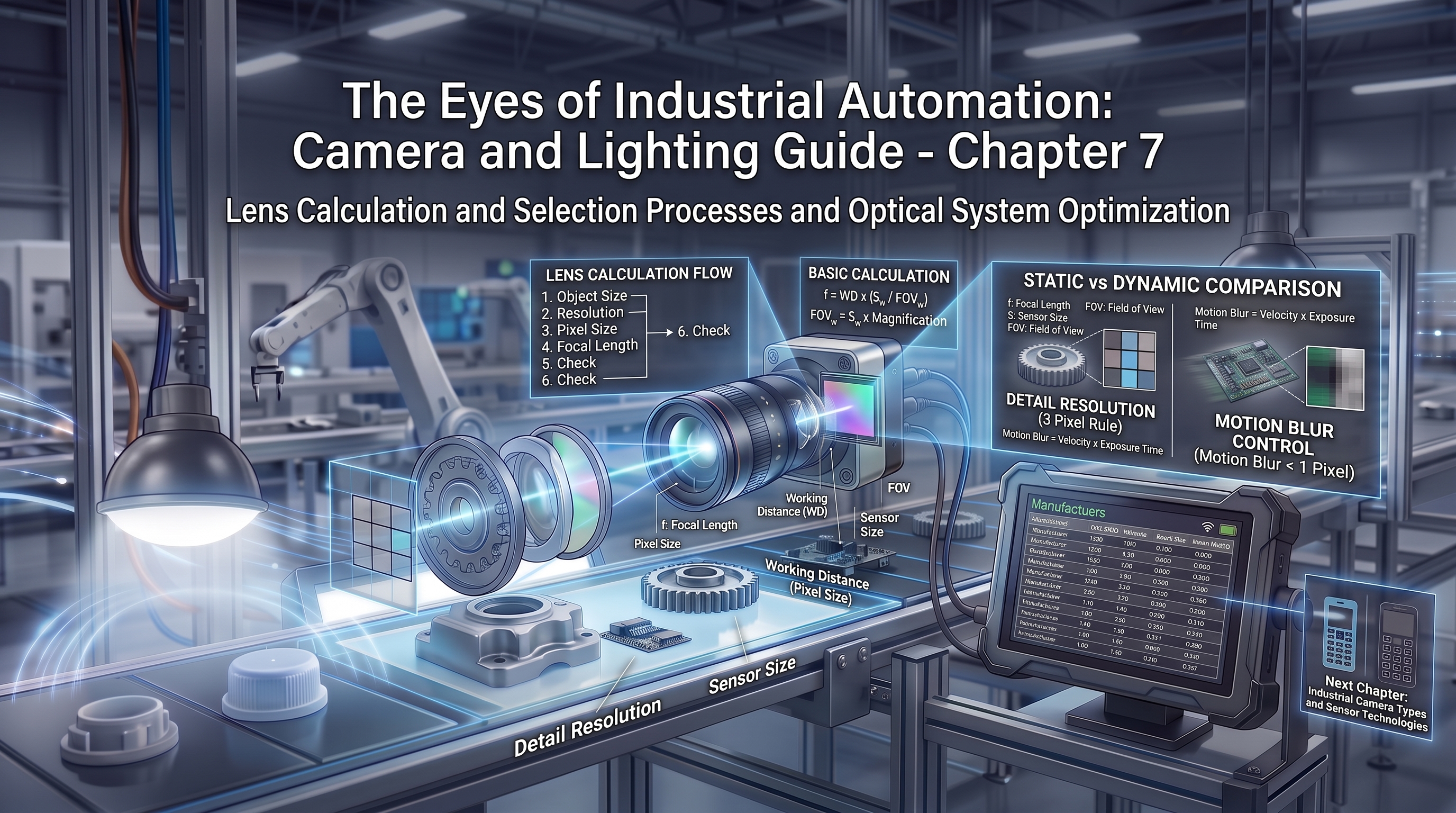

In the earlier parts of our series, we explored in detail the invisible heroes of industrial automation systems: lighting technologies, surface interactions, and optical filters. However, no matter how flawless a lighting setup you build, your system is not complete without the structure that transports that precise light reflected from the scene to the camera sensor without deviation. The critical bridge that collects and focuses the light, ultimately determining the geometric fate of the image, is the lens.
In this installment of our blog series, we step into the optical heart of machine vision systems: Lens Technologies and Lens Types.
3. LENS
In industrial machine vision systems, lenses are among the most critical optical components, ensuring that the light coming from the scene is accurately focused onto the image sensor. No matter how high the performance of the camera sensor is, an inappropriate lens selection can severely degrade image quality. Therefore, the lens is the fundamental element that directly affects all imaging parameters, such as resolution, field of view (FOV), depth of field (DOF), and geometric accuracy.
3.1 Lens Types
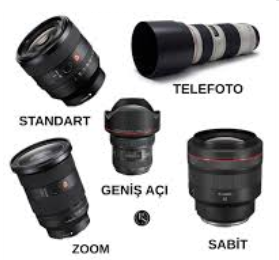
Various lens types are used in industrial applications to meet different needs:
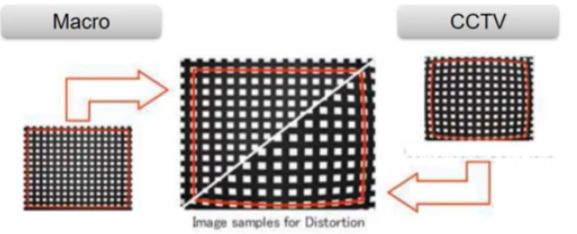
CCTV Lenses: These are lenses used for general-purpose imaging and have a wide range of applications. They are widely preferred due to their low cost and availability in various focal lengths. However, they may exhibit limited performance in precision measurement applications due to optical distortion.
Macro Lenses: These lenses are designed to capture high-level detail from very close distances. They are used for inspecting small parts, electronic components, and micro-surface defects. Thanks to their high magnification ratio, their detail resolution is exceptionally high.
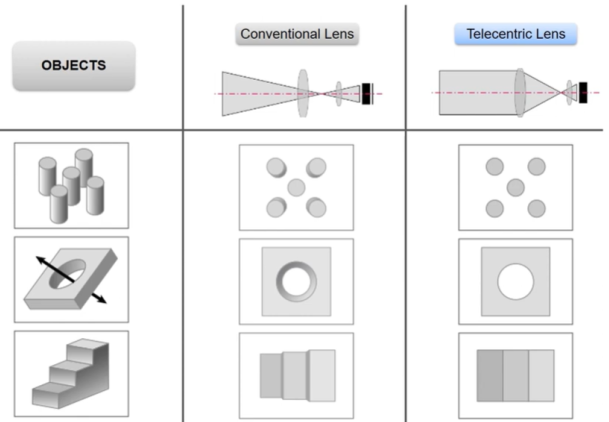
Telecentric Lenses: These are considered the most precise measurement lenses in industrial imaging. They eliminate perspective errors (parallax), ensuring that the object is imaged at the exact same size even if its distance from the lens changes. This feature provides a critical advantage, especially in metrology, quality control, and precision dimensional analysis applications.
Zoom Lenses: These are lenses with variable focal lengths. They provide flexible imaging capabilities at different distances. Although they offer setup flexibility in industrial systems, they may have certain limitations in terms of optical quality and geometric accuracy compared to fixed-focal-length (prime) lenses.
Feature | CCTV | Macro | Telecentric |
Perspective Error | Present | Present | Eliminated (None) |
Measurement Precision | Low | Medium | Very High |
Working Distance | Flexible | Short | Fixed / Narrow |
Lens Comparisons
Macro vs. CCTV Lens: While macro lenses are optimized for high magnification and close-range details, CCTV lenses are used for general-purpose imaging over wider areas. Therefore, macro lenses offer high resolution and fine detail, whereas CCTV lenses provide flexibility and a broad range of use.
Telecentric vs. Non-Telecentric Lens: Telecentric lenses eliminate perspective error, ensuring maximum measurement accuracy. In non-telecentric (standard) lenses, the image size changes depending on the object's distance, which can negatively impact measurement precision.
In summary, choosing the right lens determines not only the clarity of the image but also the accuracy of the dimensional measurements and defect analyses your software will perform. The wrong lens choice can condemn even the most advanced cameras to produce misleading data.
Now that we have grasped the fundamental building blocks of optical components and lens types, we can move on to examining the physical parameters that determine the performance of these lenses in the next stage.
In the continuation of our series, we will take a deep dive into the parameters that play a critical role in lens selection: Focal Length, Field of View (FOV), Working Distance (WD), and Depth of Field (DOF). Stay tuned!