
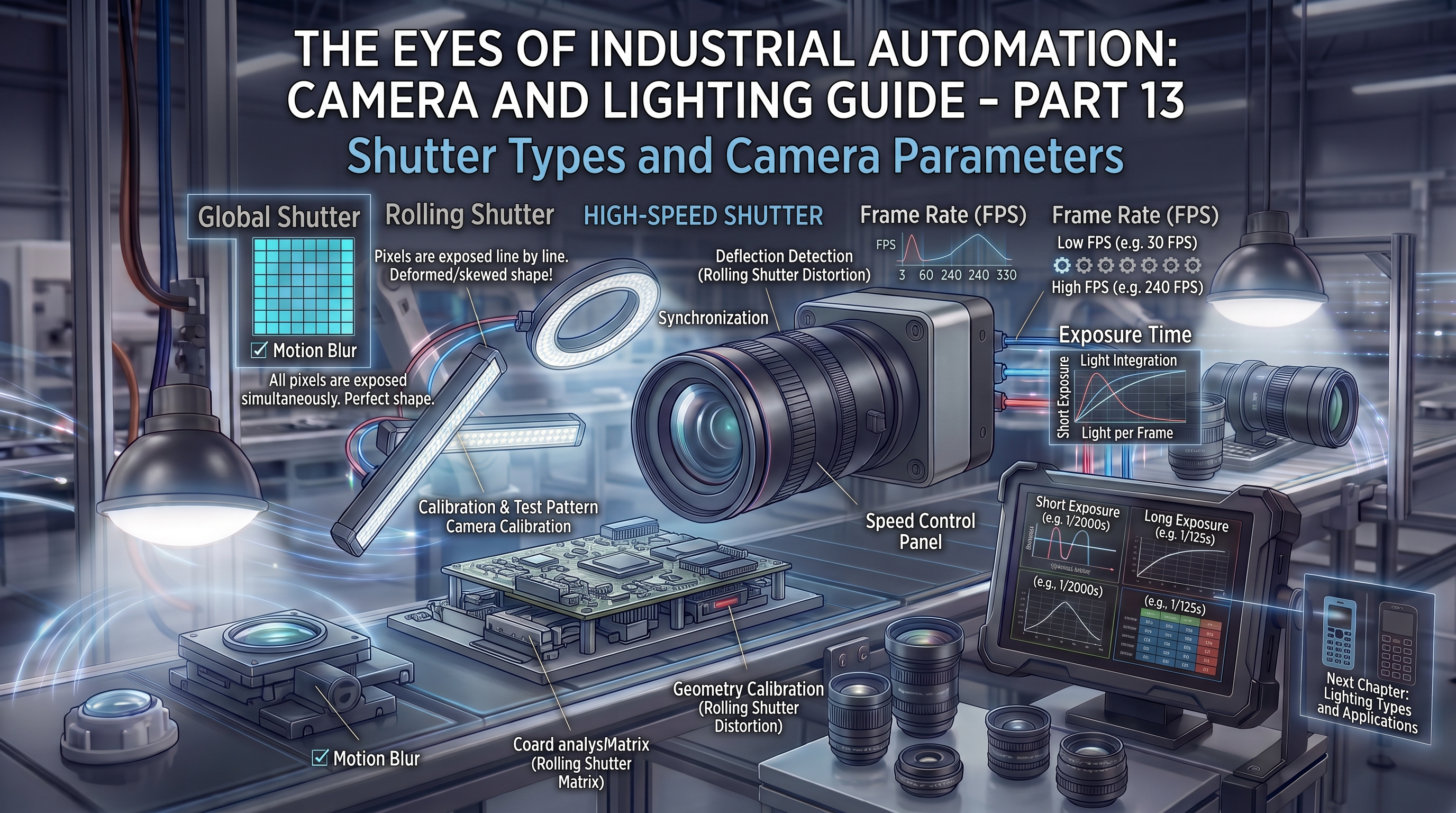
The Eyes of Industrial Automation: Camera and Lighting Guide - Part 13
In our previous section, we addressed the physical architecture of image sensors, CCD and CMOS differences, and digital image formats. However, specifying sensor architecture alone is not sufficient; "freezing" an object without motion blur on a high-speed production line and obtaining accurate data depends on how exposure timing is executed. In this section of our series, we discuss Shutter Types (Global vs. Rolling) and Basic Camera Parameters that dictate the fate of moving parts.
4.3 Shutter Types
In industrial imaging systems, the shutter mechanism is one of the fundamental components determining how the sensor is exposed to light. The shutter type has a direct impact on image fidelity and geometric distortions, particularly when imaging moving objects.
Two main shutter methods are used in image sensors: Global Shutter and Rolling Shutter. The difference between these two methods stems from the timing of light collection and readout across the pixels on the sensor.
4.3.1 Global Shutter
In a global shutter architecture, all pixels on the sensor are exposed to light simultaneously, and the image is captured at the exact same moment. The entire image frame is recorded synchronously during the exposure duration, and the data is read out afterward.
This structure provides a major advantage, especially in imaging moving objects. Even if the object is in motion, no geometric distortion occurs because the entire image belongs to a single instant in time. Consequently, artifacts such as skew, wobble, or spatial deformation do not occur in the image.
Global shutter is of critical importance in the following applications:
High-speed production lines
Robotics and automation systems
Part tracking and positioning
Metrology applications
However, this technology has certain drawbacks. Global shutter sensors typically possess a more complex pixel architecture, which can lead to smaller pixel sizes and reduced light sensitivity. Additionally, their cost can be higher compared to rolling shutter sensors.
4.3.2 Rolling Shutter
In a rolling shutter architecture, pixels on the sensor are exposed and read out line-by-line rather than simultaneously. In this case, different regions of the image are captured at different instances in time.
This readout method can cause various geometric distortions, especially with moving objects. While the object or camera is in motion, effects such as skew, wobble, or deformation can be observed in the image. This situation can severely affect measurement accuracy.
However, rolling shutter sensors also offer significant advantages:
Lower cost
Higher resolution options
Better light sensitivity (larger effective pixel area)
Low power consumption
For these reasons, rolling shutter sensors are preferred in the following scenarios:
Static or slow-moving systems
General imaging applications
Artificial intelligence and classification-based systems
4.3.3 Comparison of Global Shutter and Rolling Shutter
The choice between global shutter and rolling shutter depends entirely on application requirements. While global shutter is preferred in moving systems and cases where measurement accuracy is critical, rolling shutter can provide sufficient performance in applications where cost and resolution are prioritized.
In summary:
Global shutter: Accuracy and motion control
Rolling shutter: Cost and general performance
Selecting the correct shutter type in industrial imaging systems is a critical design parameter that directly affects not only image quality but also system reliability and measurement accuracy.

4.4 Basic Camera Parameters
In industrial image processing systems, camera performance is determined not only by sensor type but also by various basic parameters. These parameters have a direct impact on image quality, detection accuracy, and system performance.
Properly understanding and optimizing camera parameters is a critical engineering process that must be evaluated together with the lens and lighting system.
4.4.1 Resolution
Resolution refers to the total number of pixels possessed by the image sensor and is one of the fundamental parameters determining the system's capacity to distinguish fine detail. High resolution makes it possible to detect smaller details.
However, resolution alone is not sufficient. It must be evaluated alongside the resolution of the optical system (lens) and pixel size. In cases where lens resolution is insufficient, a high pixel count provides no meaningful advantage.
4.4.2 Pixel Size
Pixel size refers to the physical dimensions of each individual pixel on the sensor and is typically expressed in micrometers ($\mu\text{m}$). Pixel size directly influences the light-gathering capacity of the sensor.
Sensors with a large pixel size:
Gather more light
Generate lower noise
Perform better in low-light conditions
Sensors with a small pixel size:
Provide higher resolution
However, require more illumination
Therefore, pixel size selection must be evaluated alongside illumination conditions and application requirements.
4.4.3 Frame Rate (FPS)
Frame rate refers to the number of images a camera can capture per second. This parameter holds critical importance, particularly in moving systems.
High frame rate:
Enables accurate tracking of fast-moving objects
Increases temporal resolution in the image
However, increasing the frame rate generally requires a shorter exposure time. This situation brings about the need for greater illumination.
4.4.4 Exposure Time
Exposure time refers to the duration the sensor is exposed to light and directly determines image brightness.
Long exposure time:
Gathers more light
Provides a brighter image
However, causes motion blur
Short exposure time:
Reduces motion blur
However, requires more light
Therefore, exposure time must be optimized together with object speed and the lighting system.
4.4.5 Dynamic Range
Dynamic range refers to the difference between the darkest and brightest areas the camera can perceive simultaneously.
Cameras with high dynamic range:
Prevent loss of detail in both bright and dark regions
Deliver more accurate results in high-contrast scenes
This feature is of great importance, especially on reflective surfaces and under complex lighting conditions.
4.4.6 Signal-to-Noise Ratio (SNR)
Signal-to-noise ratio refers to the ratio of the acquired image signal to noise and serves as an important indicator of image quality.
High SNR value:
Cleaner and clearer image
More reliable analysis results
Low SNR value:
Noisy image
Increased risk of false detection
SNR is affected by factors such as pixel size, sensor quality, exposure time, and illumination level.
4.4.7 Evaluating Camera Parameters Together
Camera parameters are not independent of one another, and changes made to one parameter often directly affect others. For example:
Decreasing exposure time → Need for more illumination
Decreasing pixel size → Higher light requirement
Increasing frame rate → Decreasing exposure time
Therefore, camera selection and settings must be optimized holistically alongside the lens and lighting system. The correct parameter combination is one of the most critical factors determining system performance.
To summarize; achieving the correct image in industrial environments depends on the harmonious operation of numerous parameters ranging from exposure time to frame rate (FPS), dynamic range, and shutter architecture. Selecting a Global Shutter plays a critical role in preventing geometric deformation in moving parts, while the balance between pixel size and SNR guarantees image clarity. Now that we have detailed the camera sensor architecture and operating parameters, we can move on to examining the transmission standards for the resulting high-volume digital data.
In the next part of our series, we will cover Industrial Camera Interfaces and Communication Protocols (GigE Vision, USB3 Vision, CoaXPress), which enable lossless and high-speed transmission of captured images to the computer. Stay tuned!