
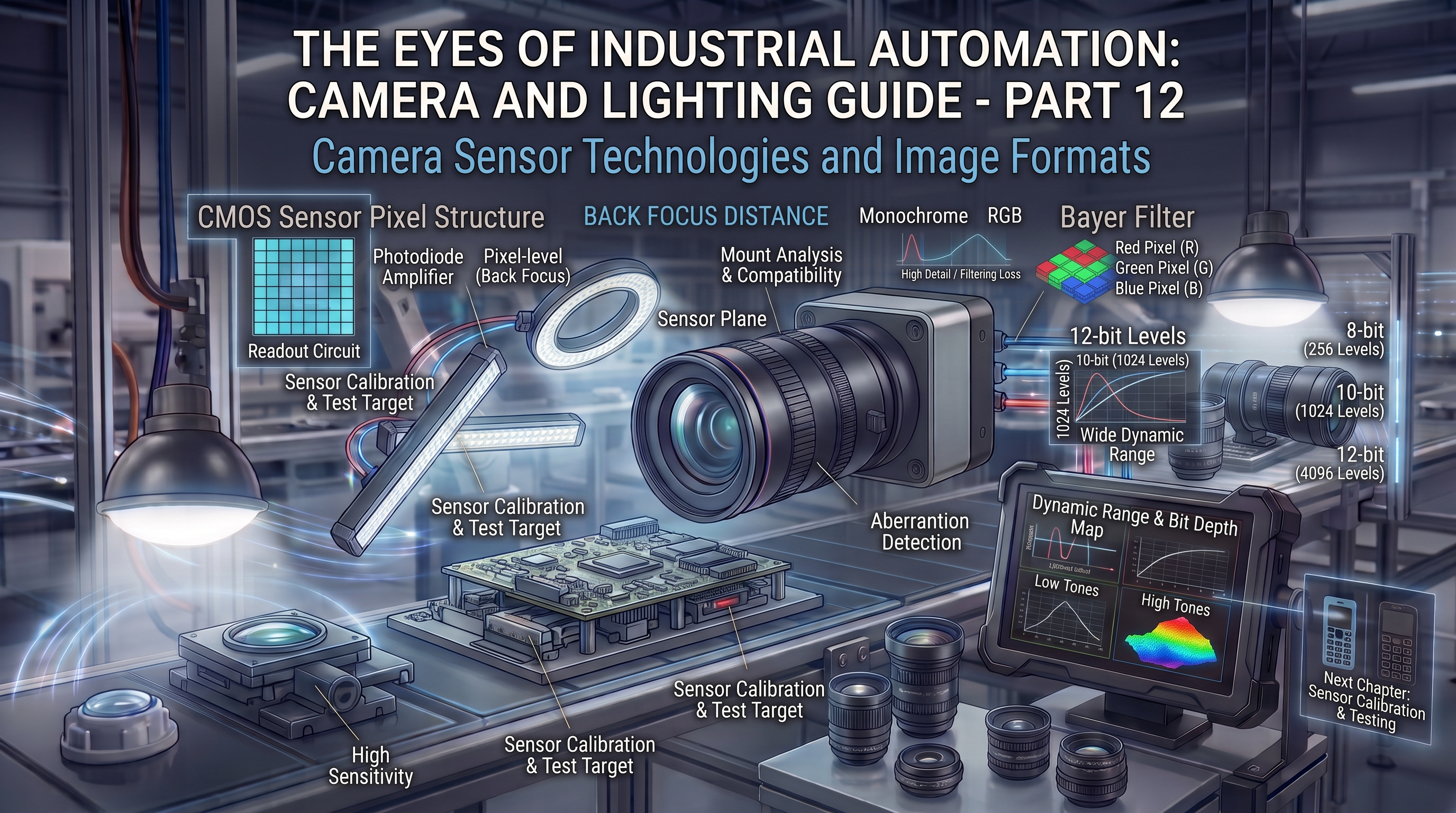
The Eyes of Industrial Automation: Camera and Lighting Guide - Part 12
In the previous parts of our series, we examined in detail lighting techniques, lens types, optical calculations, and innovative focusing technologies to create a flawless imaging environment. However, these light waves reflecting off the target object and passing through the lens must be converted into digital data that computers can understand. This is where industrial cameras and sensors—the digital retina of machine vision systems—come into play. In this section of our series, we put on the table Camera Sensor Technologies and Image Formats, which bridge optical data with the digital world.
4. Camera
4.1 Camera Sensor Technologies
In industrial image processing systems, one of the most critical components determining camera performance is the image sensor. The sensor converts light focused by the optical system into electrical signals, enabling the formation of a digital image. The quality of this conversion process directly affects image sharpness, noise level, dynamic range, and overall system performance.
Today, the two most commonly used fundamental sensor technologies in industrial applications are Charge-Coupled Device (CCD) and Complementary Metal-Oxide Semiconductor (CMOS) sensors. Both technologies have distinct operating principles and performance characteristics.
4.1.1 CCD Sensors (Charge-Coupled Device)
CCD sensors operate on the principle of sequentially transferring the charge created by incoming light on each pixel across the sensor. In this structure, charges accumulated across all pixels are shifted line by line to the sensor's output node, where they are converted into an analog signal.
Thanks to this architecture, CCD sensors are known for their high image quality and low noise levels. Reading all pixel data through a single output node minimizes pixel-to-pixel variations, providing a more uniform and stable image. For this reason, CCD sensors were particularly preferred in measurement and scientific imaging applications requiring high precision.
However, CCD sensors have several major drawbacks. Their operating principle based on charge transfer limits readout speed, making it difficult to reach high frame rates. Additionally, high manufacturing costs and greater power consumption requirements have diminished the use of these sensors in modern industrial systems.
4.1.2 CMOS Sensors (Complementary Metal-Oxide Semiconductor)
CMOS sensors enable light to be converted directly into electrical signals and processed locally, thanks to active electronic components located at each pixel. In this architecture, because each pixel can be read independently, data transfer occurs in parallel.
This feature grants CMOS sensors the advantage of high readout speeds and low power consumption. At the same time, the compatibility of their manufacturing processes with standard semiconductor technologies offers a significant cost advantage. Today, CMOS sensors are widely used in industrial imaging systems requiring high resolution, high frame rates, and flexible integration.
Modern CMOS sensor technologies have largely eliminated past disadvantages such as high noise and low image quality. Thanks to advanced pixel architectures, dynamic range and signal-to-noise ratio have been significantly improved.
4.1.3 Comparison of CCD and CMOS Sensors
The fundamental differences between CCD and CMOS sensors stem from their operating principles and performance characteristics. While CCD sensors offer high image quality and low noise advantages, CMOS sensors stand out in terms of speed, flexibility, and low power consumption.
In industrial applications, sensor selection is made based on system requirements. While CCD sensors may be preferred in specialized applications requiring high accuracy and low noise, CMOS sensors have become dominant in most machine vision applications today.
Particularly in high-speed production lines, real-time image processing systems, and artificial intelligence-based analysis applications, CMOS sensors are accepted as the standard solution due to the performance and cost advantages they offer.
4.2 Sensor Structure and Image Format
4.2.1 Sensor Size
Sensor size refers to the physical dimensions of the camera sensor and is typically specified in inches (for example: 1/2", 1", 2/3").
Sensor size directly affects the following parameters:
Field of View (FOV)
Light-gathering capacity
Lens compatibility
Image quality
Large sensors:
Gather more light
Provide higher dynamic range
Generate lower noise
Small sensors:
Offer more compact systems
Are lower cost
However, require more illumination
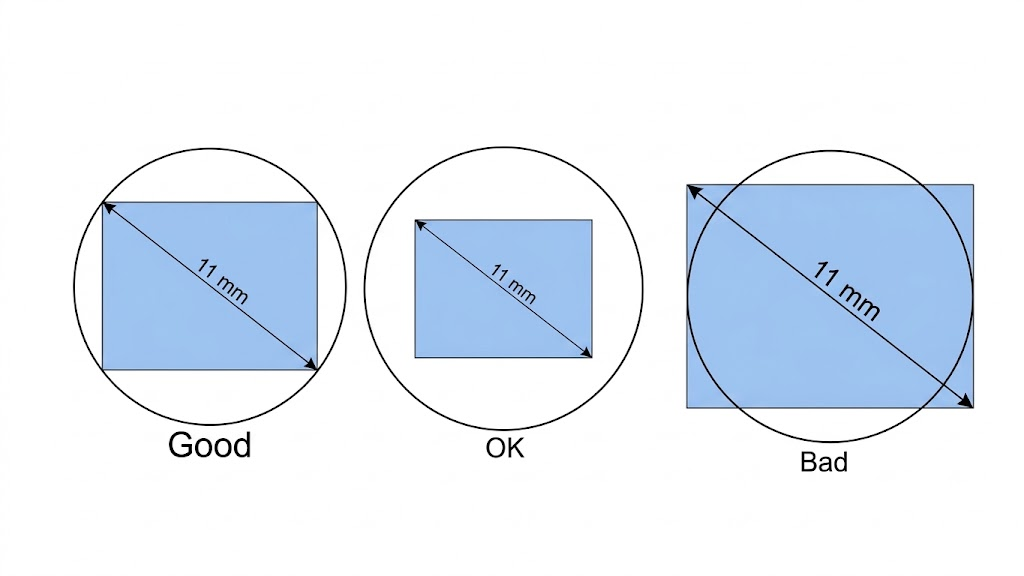
Additionally, there is a direct relationship between sensor size and lens selection. The image circle of the lens must be chosen to fully cover the sensor. Otherwise, darkening at the image edges (vignetting) may occur.
4.2.2 Image Format
Image format refers to how data obtained from the camera is represented, affecting both the data processing workflow and system performance.
Primary image formats:
Monochrome (Grayscale):
Contains a single channel.
Provides higher sensitivity.
Is the most widely used format in industrial applications.
RGB (Color Image):
Contains three channels (Red, Green, Blue).
Used for color-based analysis.
Requires more data and processing power.
Bayer Pattern:
Is the raw data format used in color sensors.
Color information is obtained through interpolation.
Bit Depth:
8-bit → 256 levels
10/12/16-bit → Higher dynamic range
High bit depth:
More precise measurement
Better contrast
Larger data size
4.2.3 Sensor – Lighting – Lens Relationship
Sensor architecture is not evaluated in isolation; it forms an integrated system alongside lighting and lens.
This relationship can be summarized as follows:
Small pixel: Need for more light
Large sensor: Need for a larger lens
High resolution: Need for more powerful illumination
Low light: Larger pixel or longer exposure
Therefore, sensor selection must be optimized together with lighting design, lens parameters, and application requirements.
To summarize; properly understanding the operating principles of CMOS and CCD sensors, the effects of sensor size on pixel performance, and image formats such as monochrome/RGB forms the cornerstone of industrial camera selection. The accurate conversion of light into electrical data at the pixel level depends on the flawless interplay of illumination intensity, lens quality, and sensor architecture. Having grasped the structure of camera sensors, we can move on to exposure mechanisms that determine image timing and quality in the next stage.
In the next part of our series, we will detail Global Shutter vs. Rolling Shutter Exposure Techniques and Basic Camera Parameters, which directly determine the clarity of moving parts. Stay tuned!