
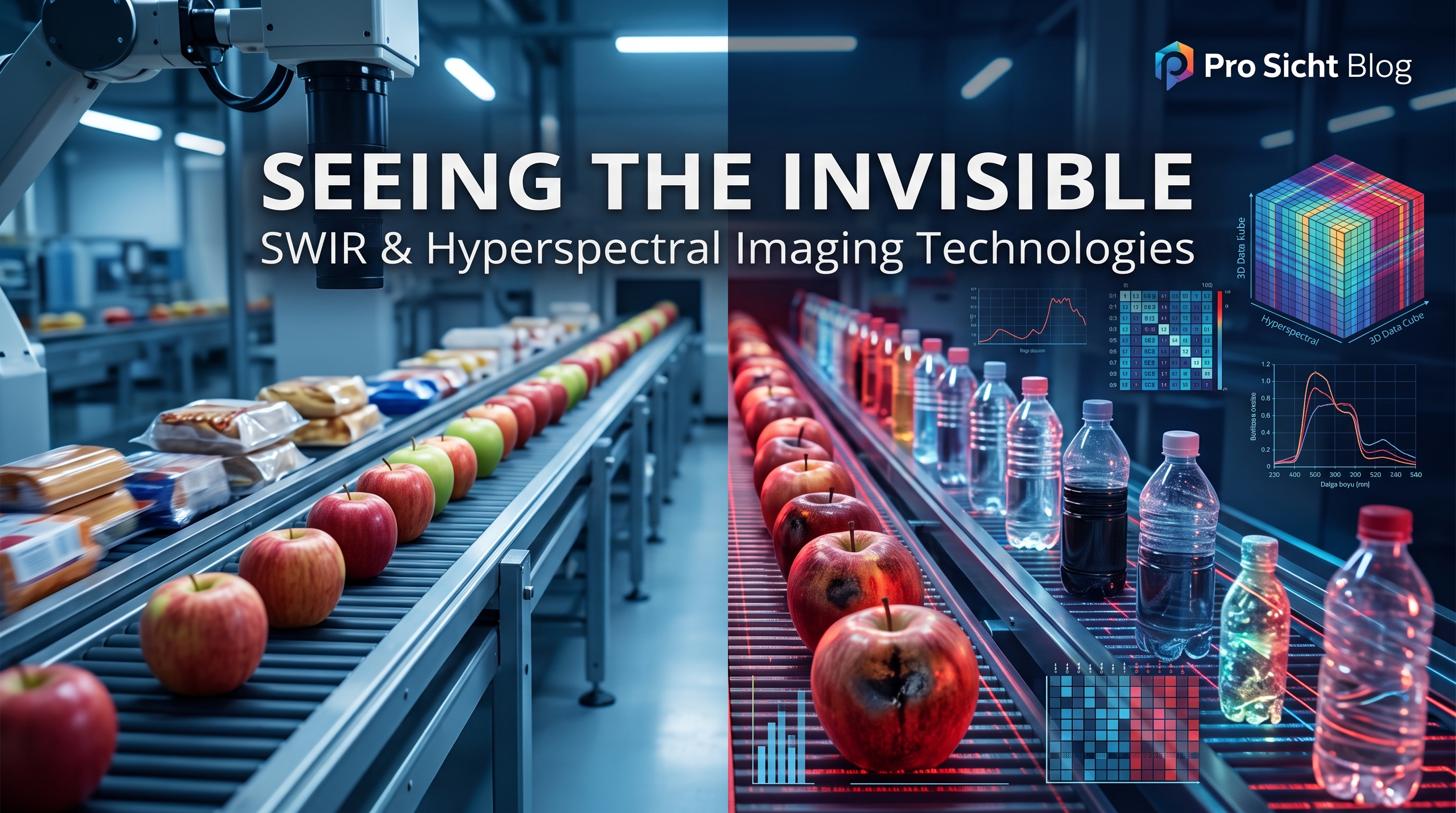
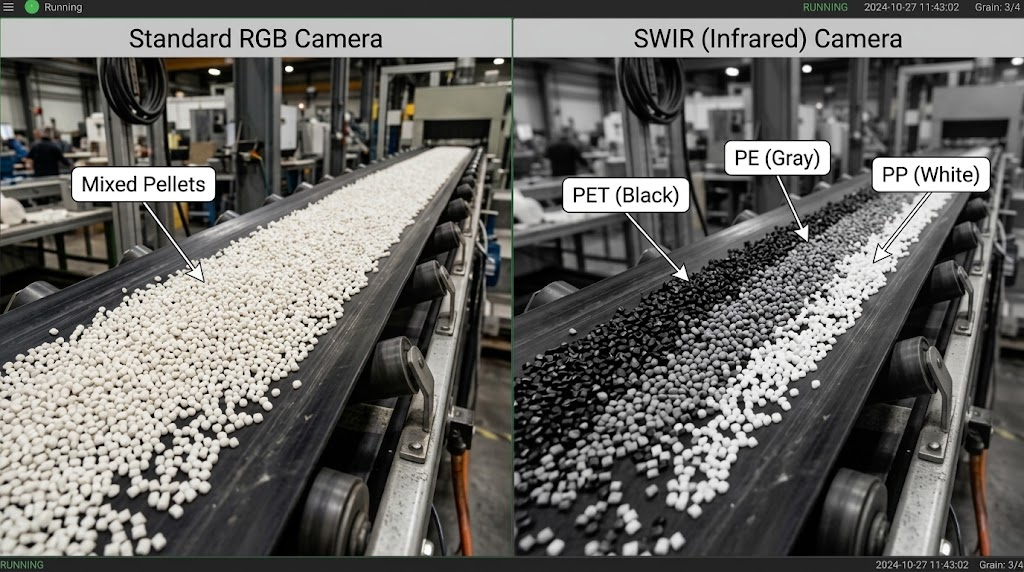
Standard industrial cameras mimic the visible light band (400 - 700 nm RGB), which is the visual spectrum of the human eye. These cameras are highly successful when the color, shape, or surface texture of an object is the determining factor. However, when it comes to sorting chemical compositions or hidden defects beneath the surface, visible light becomes completely inadequate.
Two different types of plastic (e.g., PET and PVC) that appear to be exactly the same color and shape from the outside, the liquid level hidden behind packaging, or a bruise inside an apple with no impact marks on its outer skin are impossible puzzles for RGB cameras.
At these points, Short-Wave Infrared (SWIR) and Hyperspectral Imaging technologies, which focus on the chemical and molecular signature of objects rather than their color, come into play.
The Molecular Signature of Photons: NIR and SWIR Wavelengths Encompassing the 900 - 1700 nm (up to 2500 nm with special sensors) band range of the infrared spectrum, SWIR technology utilizes the molecular interaction of light with the object. When photons strike the surface of a material, the hydrogen atomic components in the material's bond structure (specifically C-H, O-H, and N-H bonds) absorb light at certain wavelengths and reflect others.
This creates a unique spectral signature specific to each material:
Water Absorption Band (1450 nm and 1900 nm): Water molecules strongly absorb specific light frequencies in the SWIR band, making the corresponding areas appear smoothly pitch-black. This physical reality enables the instant detection of internal bruises/rot in fruits and vegetables, moisture content in foods, or tobacco/paper structures that have lost their moisture.
Polymer Sorting: While a white PET bottle and a white HDPE container appear identical to an RGB camera, they exhibit different spectral signatures under the SWIR band, allowing them to be directed to the correct sorting channels on a conveyor belt within seconds.
Seeing Through Packaging and Foreign Object Detection One of the biggest advantages of SWIR wavelengths is their ability to penetrate certain opaque materials. Thin plastic packaging, silicone layers, or dark-colored liquids that visible light cannot pass through become transparent under SWIR light.
Liquid Level and Packaging Inspection: The fill level inside dark-colored or matte plastic bottles, sealing gasket defects under the cap, and air bubbles in the sealing area are inspected non-destructively.
Foreign Object Detection in Food: On flour, rice, frozen food, or nut lines, transparent plastic pieces, glass shards, stones, or cardboard pieces that are the same color and size as the food are instantly distinguished using a SWIR camera. This is because the spectral absorption curves of the food and the foreign object are completely different.
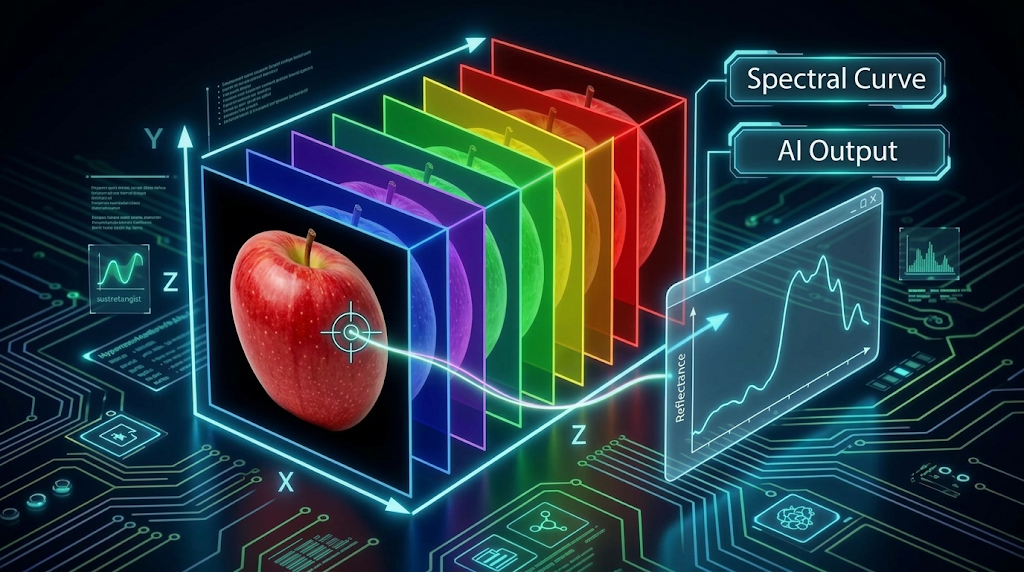
Hyperspectral Data Cubes and Artificial Intelligence Integration While a standard RGB camera provides 3 color channels (R, G, B) for each pixel, a Hyperspectral Camera records hundreds of narrow and continuous wavelength channels for each pixel across a wide spectrum between visible light and the infrared band.
As a result of this process, a 3D data structure called a Hyperspectral Data Cube emerges: The X and Y coordinates represent the spatial image, while the Z-axis represents the wavelength spectrum at that pixel.
Massive Data Size and the AI Solution The size of the data flowing from a hyperspectral camera is quite heavy for standard image processing algorithms. Machine Learning and Deep Learning models come into play for processing this massive volume of spectral data:
Dimensionality Reduction: Using methods like PCA (Principal Component Analysis), 3-5 critical "golden wavelengths" with the highest discriminative power are selected from hundreds of wavelength bands.
Spectral Classification (1D/3D CNN & PLS-DA): AI models compare the spectral curve of each pixel in the data cube with the database they were trained on. Thus, the fat/protein ratio in meat products, microbial spoilage in foods, or active ingredient homogeneity in pharmaceutical tablets are mapped pixel by pixel.
The Engineering Power of Seeing the Invisible In challenging environments where traditional quality control systems are deadlocked and color and shape similarities remain unsolvable, SWIR and Hyperspectral imaging systems create a true turning point. With advancements in InGaAs sensor technologies and the increase in GPU processing power in edge devices, these systems have moved out of laboratory environments and become capable of being integrated into high-speed factory lines.
Keep following the Pro Sicht Blog for technical guides and solutions that will empower your industrial vision systems at the physical and chemical level!