
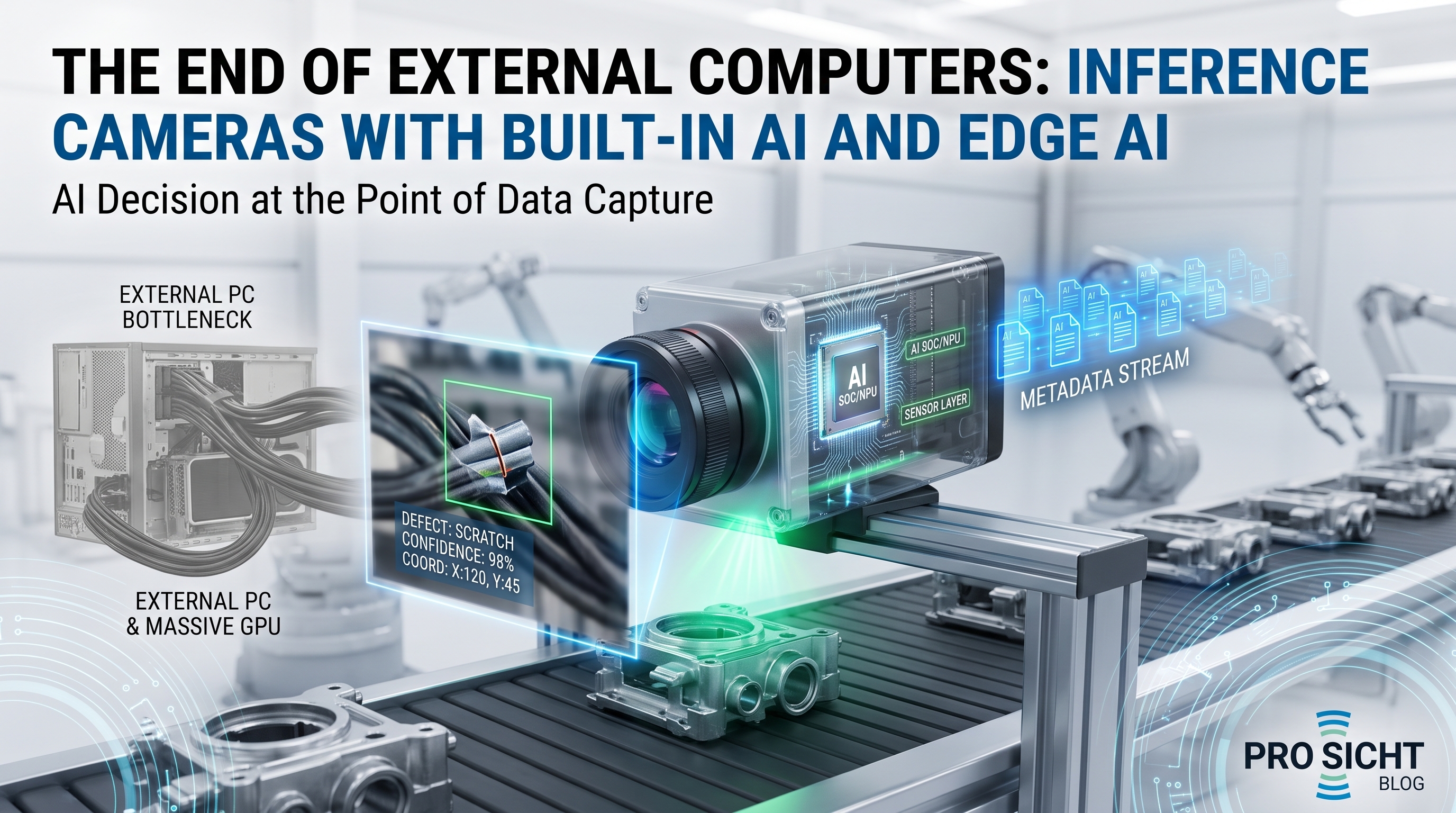
When setting up a traditional industrial image processing system, the standard architecture is clear: One or several GigE/USB3 cameras mounted on the line, thick cable harnesses carrying the gigabytes of raw data flowing from these cameras, and an expensive Industrial PC (IPC) with powerful GPUs placed inside the panel. Although this architecture has proven itself for years, it creates serious cost and complexity in confined machines, high-speed conveyors, or lines with a large number of cameras. So, what happens if we take the camera from being just an 'image collector' and transform it into a smart headquarters that performs artificial intelligence inference directly inside its housing? This is exactly where Inference Cameras (Smart Cameras with Built-in AI Support) come into play.
Bottleneck in the Field: Bandwidth, Latency, and Panel Cost The biggest engineering obstacle encountered in classical systems is data transmission. When a camera produces tens of frames of high-resolution raw images per second, transporting this data over the network to the computer saturates the network bandwidth. Furthermore, transmitting the image to the computer, transferring it to GPU memory, passing it through the model, and sending the decision back to the PLC causes delays at the millisecond level. Inference cameras reverse this logic: 'Do not bring the data to the decision, take the decision to the data.' The moment the image leaves the sensor, it is processed by the NPU (Neural Processing Unit), TPU, or embedded system-on-chip (SoC) on the camera's own board. Gigabytes of video streams do not pass over the network; the camera only sends metadata to the outside world within milliseconds: 'At coordinate X:120, Y:45, Defect Type: Scratch, Confidence: 98%'.
How Does Inference Camera Architecture Work? Modern inference cameras present themselves with two main architectural approaches:
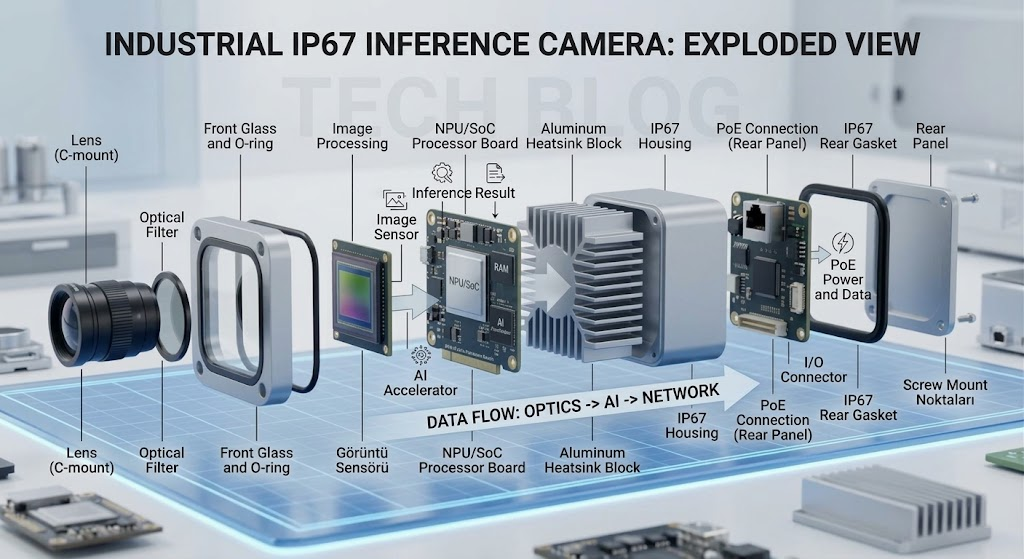
On-Board Processing: Inside the camera, alongside the image sensor, there is an embedded processor board (e.g., NVIDIA Jetson Orin Nano, Hailo-8, or Ambarella chipsets). The raw data coming from the sensor is transferred directly to this chip, and pre-quantized (INT8/FP16) AI models run here.
Sensor-Level Processing: This is the pinnacle of chip technology. In innovative sensors like the Sony IMX500, there is an artificial intelligence processor layer integrated right below the photodiode layer. The image is subjected to AI inference at the sensor level before it even fully converts into a digital signal.
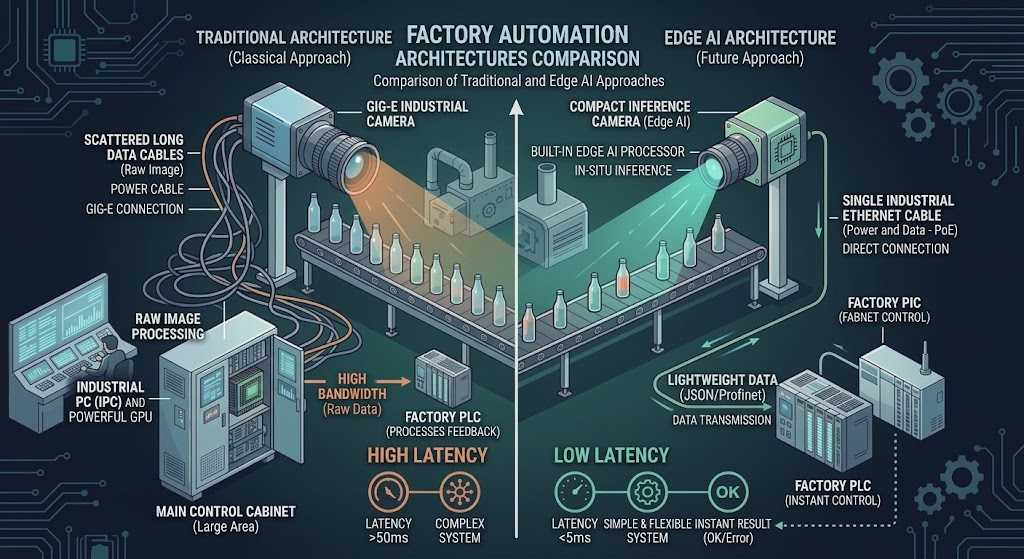
When to Use an Inference Camera, When to Use an Industrial PC? Although inference cameras offer a great solution, they are not a silver bullet for every project. To choose the architectures correctly, the following engineering criteria should be considered:
When Should an Inference Camera Be Chosen?
When there is a space constraint in the panel and an additional IPC cannot be installed.
In standalone/independent stations and tight-budget projects.
In situations where only a 'Defective/Good' signal or coordinate data will be generated and transferred to the PLC.
When low power consumption (PoE - Power over Ethernet) is targeted.
When Should Centralized IPC Architecture Be Chosen?
On complex lines where a large number of high-resolution cameras work synchronously with each other to create a common point cloud or 3D data.
When very large and unquantizable heavy artificial intelligence models (Large Vision Transformers, etc.) run.
In massive data processing scenarios that require high VRAM.
Hidden Obstacles in the Field: Heating and Model Management There are two critical challenges engineers face when deploying inference cameras in the field:
1. Thermal Limits When you put a high-performance AI chip inside a small, closed camera housing with an IP67 protection class, your biggest enemy is heat. The passive cooling capacity of cast aluminum bodies is limited. When the chip overheats, it drops its frequency, and the inference speed can suddenly drop. Therefore, model optimization is not a choice, but a necessity in inference cameras.
2. Remote Model Management Imagine 30 independent inference cameras operating in a factory. When you update the model, it is impossible to connect to the cameras one by one and load it manually. At this point, MLOps and remote device management come into play. Cameras must be remotely updatable from a central server via Docker containers.
Conclusion Inference cameras simplify complex system architectures, bring system latencies close to zero, and reduce the total cost of ownership by bringing artificial intelligence to the furthest edge of the factory (Edge). An embedded vision system designed with the right hardware selection and model optimization frees your automation lines from external computer loads, making them much more flexible and agile.
Keep following the Pro Sicht Blog for technical reviews on industrial image processing, Edge AI hardware, and embedded system architectures!