
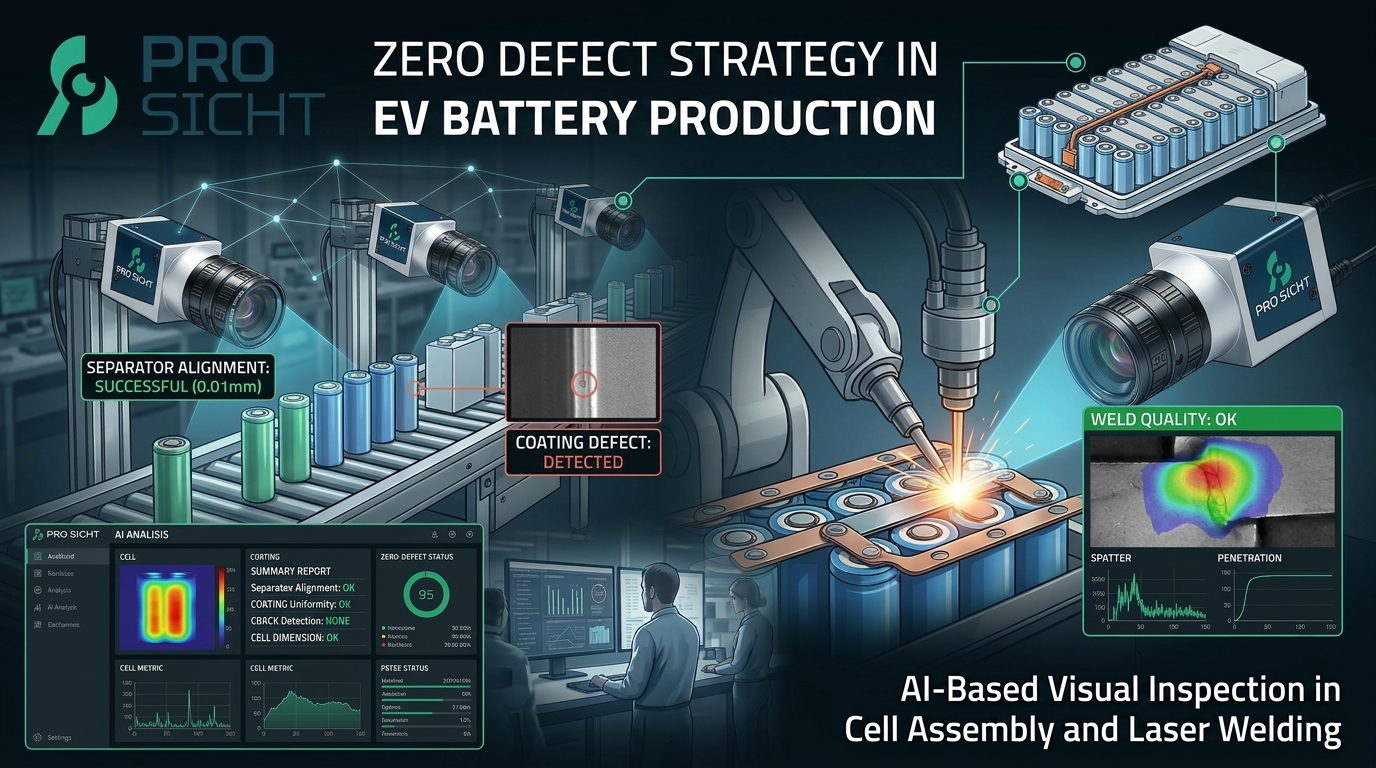
As the automotive industry's shift toward electric vehicles (EVs) continues at full speed, a single critical component sits at the center of this revolutionary change: battery packs. Yet these massive energy stores, built from thousands of cells, do not forgive even the smallest production errors, down to a hundredth of a millimeter. While traditional quality control methods fall short at high line speeds and at micron-level detail, a "zero-defect" strategy in battery safety is no longer a choice but a vital necessity.
1. The Critical Threshold in Battery Manufacturing: Why Zero Defects?
Lithium-ion batteries, the heart of an electric vehicle, go through extremely rigorous processes because of their chemistry, high energy density and demanding production requirements. Even the smallest defect missed on the production line can lead to field failures, customer dissatisfaction and recalls costing billions of dollars. More importantly, these defects can trigger the risk of catastrophic thermal runaway.
Manufacturers face two major pressures at the same time:
- Safety: Meeting the standards of consumers and regulatory bodies at the highest level.
- Cost Efficiency: Reducing scrap rates and minimizing end-of-line costs.
2. Critical Failure Points: Cell Assembly and Laser Welding
There are two critical stages in the battery production process where defects occur most often and carry the highest risk:
a. Cell Assembly and Separator Alignment
During the assembly of the cell's internal components, a microscopic shift in the alignment of the separator that keeps the anode and cathode layers apart sets the stage for internal short circuits. Likewise, inhomogeneities in the coating surface and micron-level cracks shorten the cell's life and increase safety risks.
b. Laser Welding Deformations at the Cell Terminals
Laser welding, used to connect cells to one another in module and pack assembly, demands high speed and precision. Weld defects such as spatter, insufficient penetration, porosity or micro-cracks increase electrical resistance and, over time, cause overheating.
3. Transformation with AI-Based Visual Inspection
It is nearly impossible for the human eye or standard rule-based machine vision systems to catch these micron-level defects at high line speeds. This is exactly where AI-Based Optical Inspection systems come in.
- Deep Learning Models: Filter out complex and variable background noise to distinguish real defects from normal variations.
- Real-Time Inline Processing: Scan every cell and every weld within milliseconds, without slowing down production.
- Predictive Quality Control: Do more than reject defective products; detect process deviations in advance so that line parameters can be optimized.
4. Strategic Benefits for Manufacturers
Integrating AI-based visual inspection systems into cell assembly and laser welding processes gives plants a direct competitive advantage:
"A zero-defect strategy is not an obstacle that raises costs; on the contrary, it is the most powerful sustainability tool, optimizing unit costs by reducing scrap rates."
- Eliminating Thermal Runaway Risks: Potential cell-internal and weld-related risks are stopped before they leave the factory.
- Preventing Recall Costs: Brand reputation is protected by raising quality standards to the highest level.
- Higher OEE (Overall Equipment Effectiveness): Uninterrupted production flow by keeping false-positive (false alarm) rates to a minimum.
Conclusion
As competition in the electric vehicle market heats up day by day, the market leaders will be those who can increase production speed without compromising on quality. Adopting AI-powered visual inspection technologies in cell assembly and laser welding offers battery manufacturers not just "assurance", but the key to staying relevant in the smart factories of the future.