
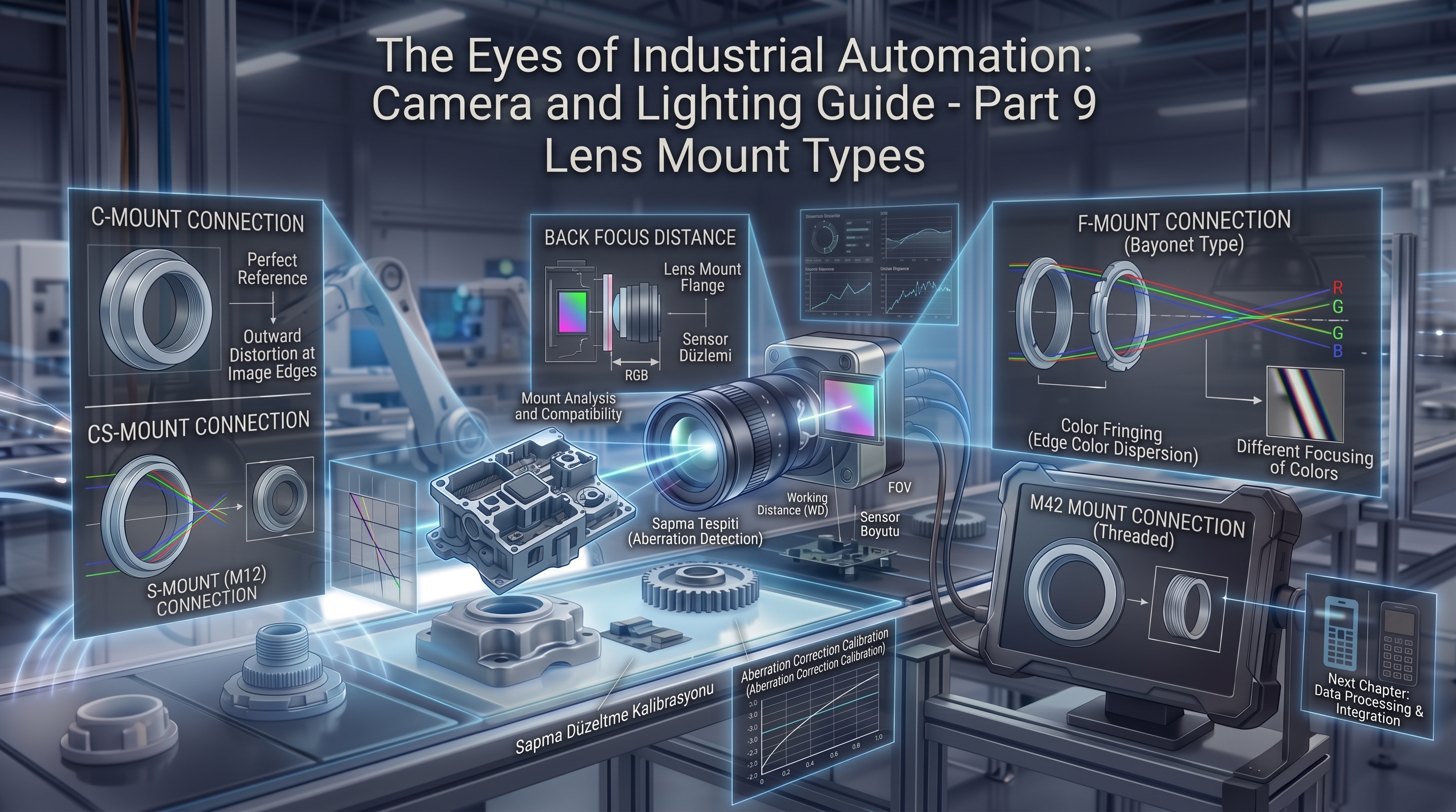
In the previous section, we examined optical aberrations and physical distortions that affect image quality. However, for a lens with flawless theoretical calculations and optical quality to perform its task in the field, it must achieve a perfect mechanical and optical match with the camera body. To achieve the correct flange distance and cover the sensor area with full efficiency, the correct mechanical interface must be selected. In this section of our series, we address the topic of Lens Mounts, which define the physical mounting standards of machine vision systems.
3.5 Lens Mount Types
In industrial imaging systems, the mechanical and optical compatibility between the lens and the camera depends on the mount type used. The lens mount type is determined by the sensor size, focal length, flange distance, and application requirements. Selecting the appropriate mount type is of critical importance for accurate system focusing and achieving maximum optical performance.
The lens mount types commonly used in the industry are explained below:
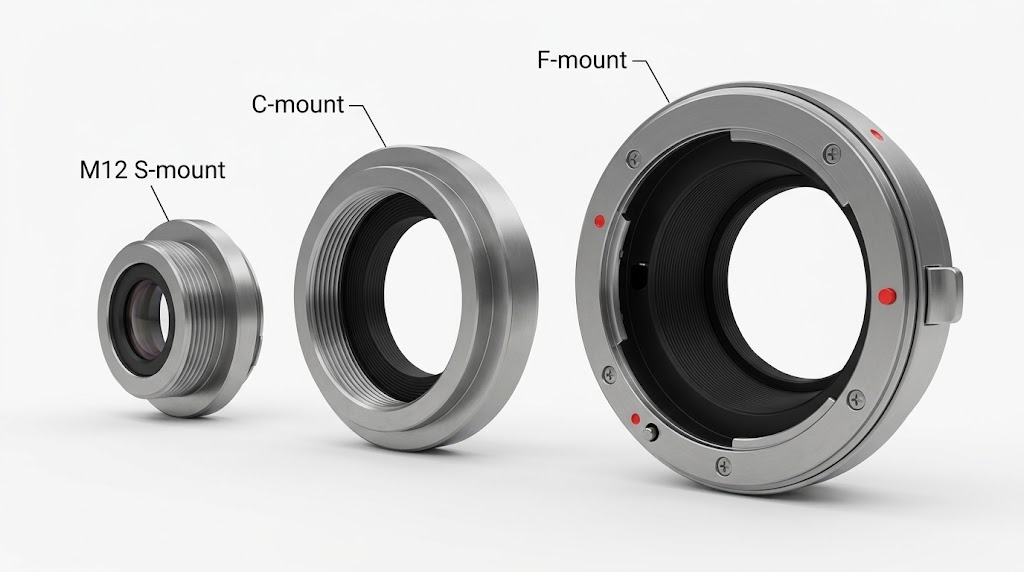
S-Mount (M12 Mount): This is the mount type used in small-sized and low-cost camera systems. It is generally preferred in embedded systems, mobile devices, and compact imaging applications. It is compatible with small sensors and has limited optical performance. It is generally not suitable for precision measurement applications.
C-Mount: This is one of the most widely used mount types in industrial imaging systems. It is compatible with sensor sizes of 1 inch and smaller. Its flange distance value is 17.526 mm. It is frequently preferred in machine vision applications because it offers a wide variety of lenses and high optical quality.
CS-Mount: It has a similar structure to the C-Mount, but its flange distance value is shorter (12.5 mm). CS-Mount cameras can be made compatible with C-Mount lenses by using an adapter. However, the reverse usage (C-Mount camera + CS-Mount lens) is not possible. It is preferred in more compact systems.
F-Mount: This is the mount type generally used in DSLR and high-resolution camera systems. It is compatible with large sensor sizes and offers high optical performance. In industrial applications, it can be used specifically in areas requiring high resolution.
M42 Mount (T-Mount): This is a mount type with a 42 mm thread diameter. It is commonly used in optical experimental systems, telescopes, and some industrial applications. It offers flexible usage possibilities and can be integrated into various systems with different adapters.
When selecting a lens mount type, not only mechanical compatibility but also sensor size, optical performance, and application requirements must be considered. An incorrect mount selection can lead to focusing problems and serious losses in image quality.
In summary; the lens mount type is not merely about screwing two parts together; it is a critical interface that directly controls the flange distance and the accuracy of focusing light onto the sensor. Choosing the wrong mount type or an incompatible adapter will prevent you from achieving focus, even with top-tier camera and lens combinations. From lighting techniques to lens types, optical parameters, mathematical calculations, aberrations, and mounting standards, we have now comprehensively completed the optical and mechanical dimensions of machine vision systems.
In the next part of our series, we transition to the primary actors that will convert all this collected and focused optical data into digital signals: Industrial Camera Types and Sensor Technologies. Stay tuned!