
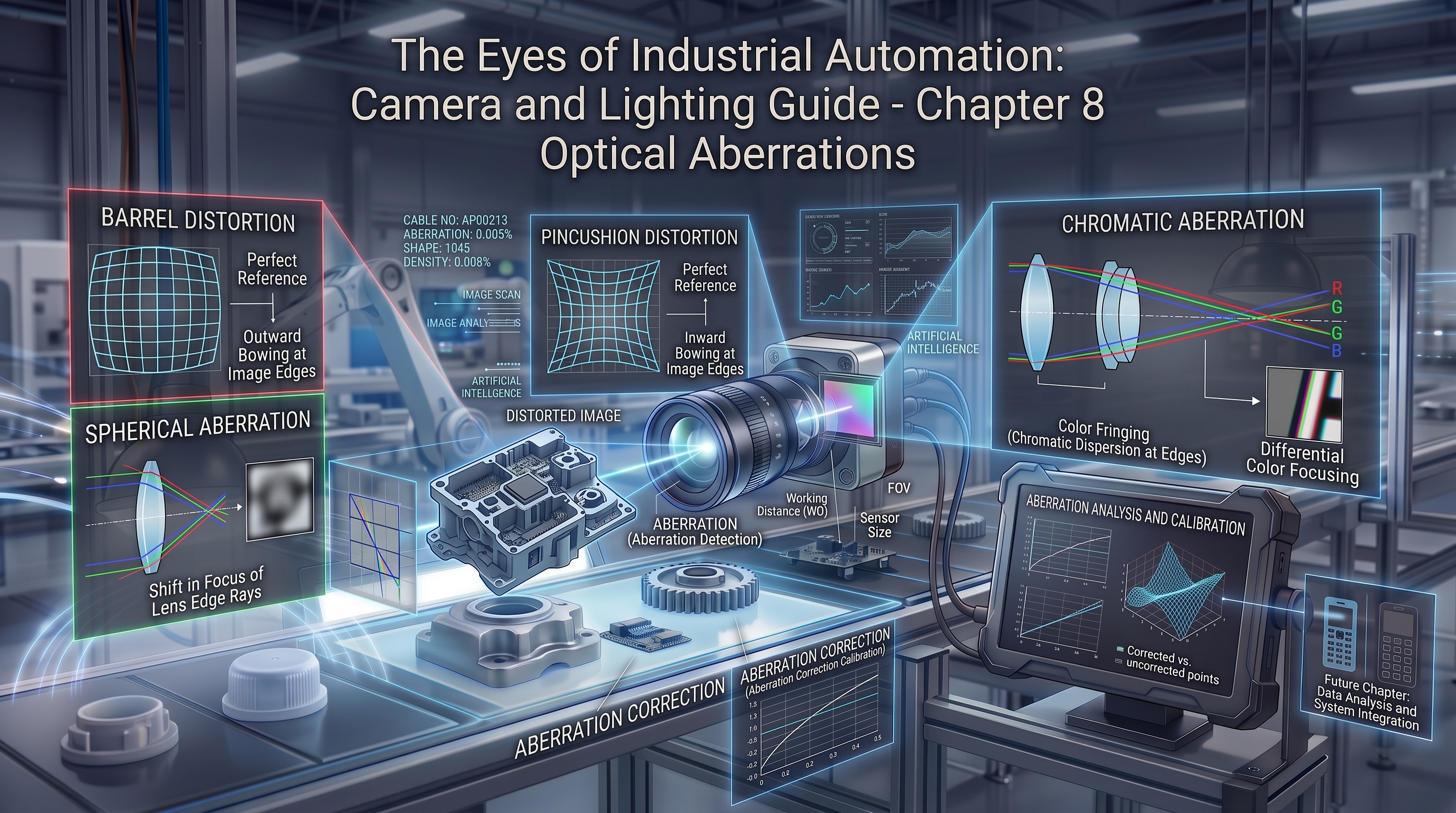
In the previous section, we covered the necessary mathematical calculations, depth of field, and motion blur management required for proper lens selection. However, even if your theoretical calculations look flawless on paper, as light travels through glass elements, it can suffer physical distortions governed by the laws of refraction. These flaws, referred to as Optical Aberrations, can distort image geometry, shift colors, or reduce overall sharpness. In this part of our series, we examine the primary optical aberrations that dictate system performance—especially in precision measurement and quality control processes—along with methods to minimize them.
3.4 Optical Aberrations
Distortion is an optical aberration that causes geometric deformation in the image. In this condition, straight lines on the object appear curved or bowed in the resulting image. Distortion can lead to severe errors, particularly in measurement and metrology applications.
Primary types of distortion:
Barrel Distortion: Occurs when magnification decreases from the center toward the edges of the image, causing straight lines to bulge outward.
Pincushion Distortion: Occurs when magnification increases from the center toward the edges of the image, causing straight lines to bow inward.
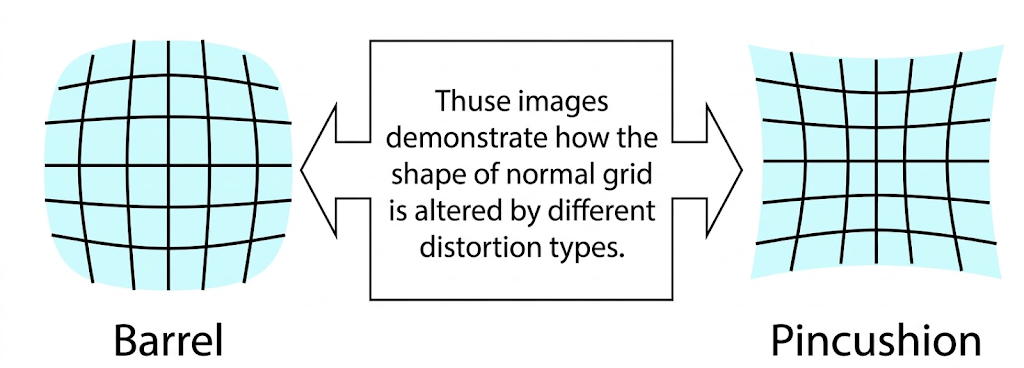
The effect of distortion typically becomes more pronounced in the peripheral regions of the image and requires software-based or optical calibration in high-precision measurement applications.
Chromatic Aberration Occurs when light of different wavelengths experiences varying refractive indices within the lens glass. This causes different color components to fail to focus at the exact same point on the camera sensor.
As a result:
Color fringing occurs along high-contrast edges.
Overall image sharpness is degraded.
It becomes particularly evident in high-contrast edge regions.
Chromatic aberration is a significant limiting factor for image quality, especially in high-resolution vision systems.
Axial / Longitudinal Aberration Arises when light focuses at different points along the optical axis. This is associated with different wavelengths or light rays entering at different angles failing to converge on the same focal plane.
Effects of this aberration:
Variations in sharpness occur across the depth of the image.
Focus shift occurs.
It becomes more pronounced at wide aperture settings (low f-numbers).
Closing down the aperture (using a higher f-number) can help reduce the impact of axial aberration.
Spherical Aberration An error stemming from the spherical geometry of lens surfaces. Light rays passing through the center of the lens and those passing through the outer edges focus at slightly different focal points.
This results in:
A reduction in overall image sharpness,
Loss of fine focus,
A decrease in contrast.
Optical aberrations directly impact key performance parameters in imaging systems:
Geometric accuracy
Measurement precision
Image sharpness
Color fidelity
Therefore, minimizing optical aberrations is of paramount importance, particularly in industrial metrology applications.
The Role of Telecentric Lenses Telecentric lenses are specifically designed to minimize optical aberrations and perspective errors in applications where geometric accuracy is critical. These lenses eliminate parallax (perspective error) during imaging, preventing the object from appearing to change size as its distance from the lens varies.
Thanks to this:
Distortion effects are minimized.
Measurement accuracy is maximized.
Reliable results are achieved in industrial metrology applications.
Correctly understanding and controlling optical aberrations plays a crucial role in designing high-accuracy industrial vision systems. Therefore, when selecting a lens, engineers must consider not only the fundamental parameters (FOV, WD, focal length) but also the lens's specific aberration characteristics.
In summary; optical aberrations are not merely aesthetic image flaws—they pose a direct risk of leading to false decisions in micron-level precision measurement and quality control processes. By utilizing telecentric lenses, stopped-down apertures, or specialized optical filters, you can keep these distortions under control and elevate your system's reliability to the highest level.
With this, we have thoroughly covered the optical foundation of machine vision systems, from lighting techniques down to complex lens parameters.
In the next part of our series, we will transition to the ultimate heroes that convert these light waves—flawlessly focused by the optical setup—into digital data: Industrial Camera Types and Sensor Technologies. Stay tuned!