
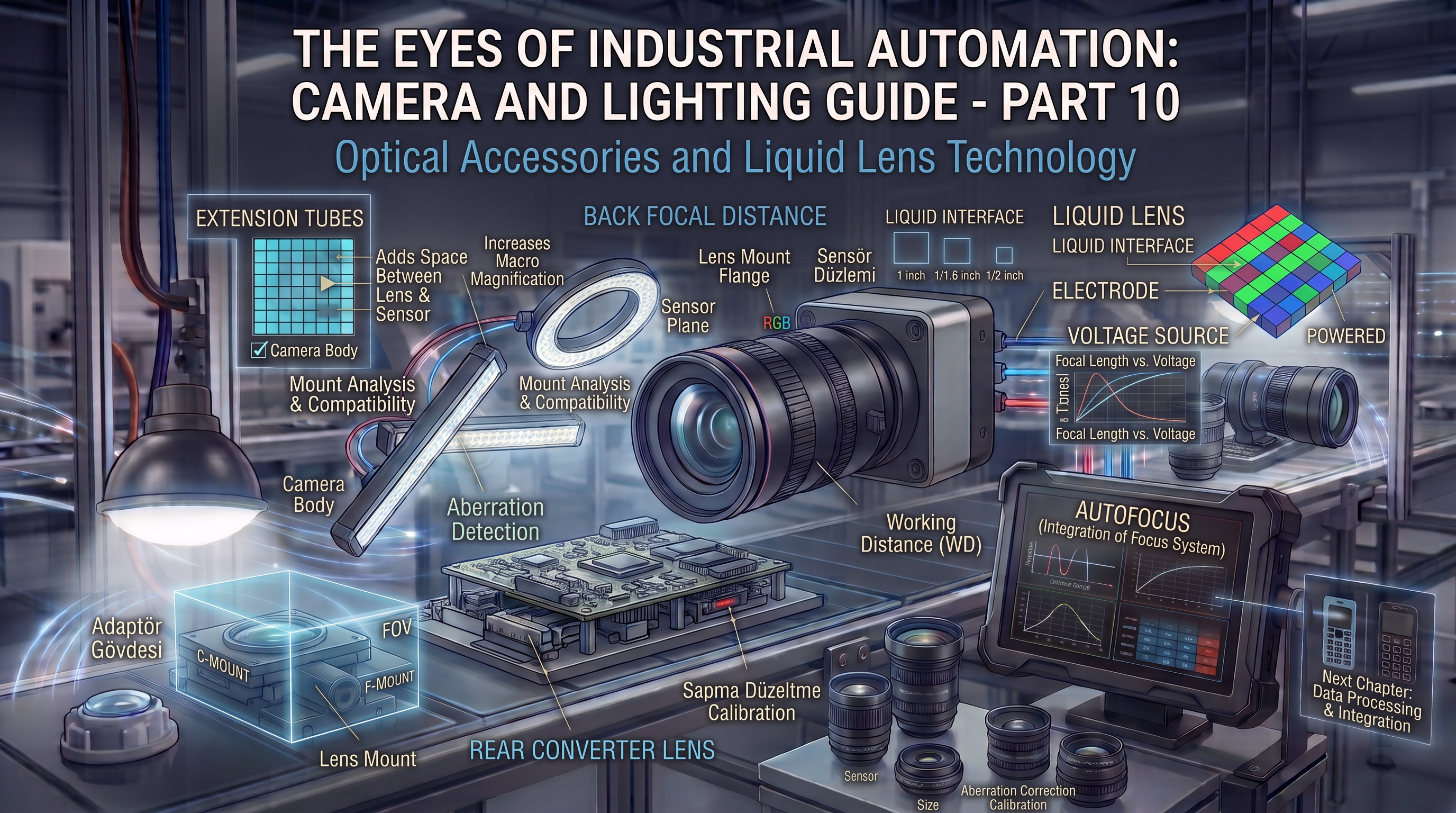
In our previous section, we examined the mount types that form the mechanical and optical interfaces between lenses and cameras. However, under variable production conditions, a standard camera-lens pair may not always offer sufficient flexibility. At times, we need optical auxiliary elements to get closer to micrometer-level details, and at other times, we require innovative technologies that can focus on fast-moving parts at varying heights within milliseconds. In this section of our series, we discover Optical Accessories that enhance the flexibility and modularity of your system, as well as Liquid Lens Technology, which is revolutionizing machine vision.
3.6 Optical Accessories and Auxiliary Components
In industrial imaging systems, selecting only a lens and camera is not always sufficient; various optical accessories are also utilized to enhance optical performance or adapt to system requirements. These components are used for purposes such as altering magnification ratios, adjusting working distances, and increasing system flexibility.
Extension tubes: Extension tubes are non-optical (containing no lens elements inside) mechanical components placed between the lens and the camera sensor to move the lens further from the sensor. In this way, the minimum focus distance is reduced, achieving higher magnification. They are particularly preferred in macro imaging applications. However, as a result of their use, the focus range narrows and the amount of light reaching the sensor may decrease.
[IMAGE: image54.png]
Extension rings: These are auxiliary elements that function similarly to extension tubes, but are generally thinner. They are used for minor focus adjustments and precise magnification changes, providing more compact solutions on the system.
Rear converter lens: These are optical elements added behind the lens. They increase the focal length to raise the magnification ratio (for example, a 2x converter). This allows a narrower field of view to be obtained from greater distances. However, because additional elements are introduced into the optical system, a loss in resolution and light can occur.
Close-up lens: These are optical elements attached to the front of the lens that lower the minimum focus distance, enabling close objects to be imaged clearly. They are generally used as a low-cost macro solution; however, the optical quality may not be as high as that of the primary lens.
Mount adaptors: These are mechanical adaptors that make different lens mount types (for example, C-mount, CS-mount, M42) compatible with each other. They provide flexibility in system integration. However, using the wrong adaptor can cause focusing issues and optical alignment errors.
The use of optical accessories should be carefully evaluated based on system needs. Although these components increase system flexibility, they can cause negative effects on optical performance, such as light loss, resolution degradation, and increased distortion. Therefore, accessory selection must be optimized together with the overall optical design of the system.
3.7 Liquid Lens Technology
[IMAGE: image56.png]
Liquid lens technology, unlike traditional mechanical focusing systems, is an innovative optical solution based on the principle of electrically altering the shape of liquid inside the lens. In these systems, the focal length is dynamically adjusted by changing the curvature of the interface between two liquids with different refractive indices.
The primary advantages of this technology are:
High durability due to containing no moving mechanical parts
Very fast focusing (at the millisecond level)
Compact structure and low power consumption
Liquid lenses are particularly preferred in:
Systems requiring autofocus,
Applications with variable working distances,
Imaging systems requiring high speeds.
However, in terms of optical performance, they may have certain limitations compared to traditional high-precision lenses. Therefore, they are generally preferred in applications where flexibility is required.
In summary; while auxiliary accessories ranging from extension tubes to close-up lenses grant flexibility to your system, Liquid Lens technology provides autofocus capability at millisecond speeds without the risk of mechanical wear. Starting from light's contact with the object, we hereby complete our vast "Lighting and Optics" guide, which encompasses filters, lens selection, optical aberrations, and the most innovative focusing technologies. We are now fully prepared to move on to the primary actors that will convert these light waves—collected from the field and flawlessly focused by the optical system—into digital data.
In the next part of our series, we will discuss Industrial Camera Types and Sensor Technologies, the digital eyes of image processing systems. Stay tuned!